Why Water Flossing and Gum Massage Matter After Full Mouth Crowns and Dental Implants

Full mouth crowns on implants can feel fixed, strong, and “tooth-like”. That feeling can be misleading. The crowns cannot decay, but the gums, implant necks, bone, and spaces under the bridge can still collect plaque.
That is where water flossing and gum massage matter. They clean areas a toothbrush misses. They also help keep the soft tissue around the prosthesis healthier.
This article is informational only. Follow the cleaning plan given by the implant dentist or periodontist, especially during healing.

Full mouth crowns on implants need different cleaning
A denture can be removed and cleaned outside the mouth. A fixed full mouth implant bridge cannot. It stays in place. That changes the hygiene routine.
A full arch prosthesis usually has several hard-to-reach zones:
The line where the crown or bridge meets the gum
The underside of the bridge
Spaces between implant-supported crowns
Areas around abutments and connectors
Small concave zones where food and plaque collect
Screw-access areas if the bridge is screw-retained
These spaces are not always visible in the mirror. Food can sit under the prosthesis without pain. Plaque can harden into calculus. Gums can become inflamed before anything feels loose.
Implants also do not have the same natural defence as teeth. A natural tooth has a periodontal ligament. This ligament gives feedback when pressure is too high and has a blood supply that helps support the surrounding tissue. An implant connects directly with bone. The gum seal around it is useful, but it is less forgiving.
That means plaque control is not optional. It protects the investment.
This is true for both cortical basal and endosseous implant systems. Corticobasal implants often use strong cortical bone support and may be used in immediate-load full mouth cases. Endosseous implants are placed inside the jawbone and are common in many full arch treatments. The design differs, but the daily hygiene rule stays the same. Plaque around implants is a problem.
The real enemy is biofilm, not food alone
Many people think the main issue is trapped rice, chapati, seeds, or meat fibres. Food trapping is uncomfortable, but the bigger issue is biofilm.
Biofilm is a sticky layer of bacteria that forms on teeth, prosthetic crowns, implant parts, and gums. It builds up every day. If it is not disturbed, it matures. Mature plaque irritates the gum tissue.
Around implants, plaque can contribute to two serious conditions.
Peri-implant mucositis
This is inflammation of the soft tissue around an implant. The gums may look red, swollen, or shiny. They may bleed during cleaning. At this stage, the bone is not yet lost. With professional care and good home cleaning, inflammation can often improve.
Peri-implantitis
This is more serious. It involves inflammation with loss of supporting bone around the implant. It can create deeper pockets, pus, bleeding, bad taste, discomfort, or loosening in advanced cases. Treatment is harder once bone loss begins.
Dental organisations such as the European Federation of Periodontology and the American Academy of Periodontology describe plaque control as a key part of preventing and managing peri-implant disease. The exact risk varies from person to person, but the principle is firm. Cleaner implant surfaces and healthier gums lower the chance of inflammation.
Crowns do not decay. Implants do not get cavities. But the tissue holding them in place can fail.
Why a toothbrush is not enough
A soft toothbrush is essential. It cleans the visible surfaces well. It also cleans the gumline if used correctly. But a toothbrush cannot spray under a fixed full arch bridge. It cannot easily reach under convex pontics or around tight embrasures.
That is why people with full mouth implant crowns often receive a hygiene kit. It may include:
A water flosser
Super floss or implant floss
Interdental brushes
A soft manual or electric toothbrush
Non-abrasive toothpaste
An antimicrobial rinse, if prescribed
A rubber tip or silicone gum stimulator
Each tool does a different job. The water flosser is useful because it sends a controlled stream of water into areas where floss may not pass. It can flush loose food and disturb plaque at the gumline.
Water flossing does not replace brushing. It also does not replace professional cleaning. It is an extra tool for difficult implant spaces.
Think of the prosthesis like a fixed bridge over a narrow gap. A brush cleans the road surface. A water flosser cleans underneath the bridge.
What water flossing does around full mouth crowns
Water flossing uses a pulsed stream of water. The stream reaches around curved surfaces and under the prosthesis. This makes it useful after full mouth implant crowns.
It flushes the underside of the bridge
The underside of a full arch bridge can hold soft plaque and food debris. This area is called the intaglio surface. The tongue may not clear it. Normal rinsing may not remove what sticks there.
Water pressure helps move debris out from under the bridge. This is especially helpful after meals with fibrous or sticky foods.
Common examples include:
Spinach, coriander, and leafy sabzis
Chicken fibres
Sesame seeds
Groundnut pieces
Fine grains
Sticky sweets
If these sit under the prosthesis, they can cause bad taste and gum irritation.
It cleans around the implant gumline
The gumline around implant crowns needs daily cleaning. Plaque gathers at the margin where the crown profile meets the tissue.
A water flosser tip can be angled along this line. This helps break up soft deposits before they harden.
The goal is not to blast the gums. The goal is controlled flushing.
It helps people with limited hand control
Many long-term denture wearers find floss threading difficult after moving to fixed teeth. The hands may not easily manage floss under a full arch bridge. Water flossing is simpler. It still needs technique, but it is easier to build into a daily routine.
This matters because the best hygiene tool is the one used every day.

How to water floss after full mouth implant crowns
Do not start aggressive water flossing immediately after surgery unless the dentist has approved it. During the early healing phase, the tissues need protection. The timing and pressure setting depend on the surgery, sutures, grafts, and prosthesis design.
Once cleared, use a simple routine.
Fill the tank with lukewarm water
Cold water can feel sharp on healing gums. Hot water can irritate tissue. Lukewarm water is safer and more comfortable.
Use clean water. In cities like Bengaluru, where many homes use filtered or RO water for drinking, the same clean water is a sensible choice for oral irrigation.
Do not add mouthwash unless the dentist recommends it. Some solutions can damage the device or irritate tissue if used too often.
Start with low pressure
Begin at the lowest setting. Increase only if it feels comfortable and the dentist has allowed it.
High pressure is not better. Too much force can make the gums sore. It can also push debris into tender areas if used poorly.
A useful rule is simple. The stream should feel firm, not painful.
Lean over the sink
Keep the lips partly closed around the tip. Let the water flow out into the sink. This prevents splashing and gives better control.
Do not turn the device on before placing the tip in the mouth.
Aim at the gumline, not straight into the tissue
Hold the tip at about a right angle to the gumline. Trace slowly around each tooth or crown.
For a full arch bridge, spend time on:
The front gumline
The back gumline
The underside of the bridge
The spaces around each implant support
Any food-trap area pointed out by the dentist
Move slowly. Do not rush across the arch.
Clean from both sides
For upper teeth, clean from the cheek side and the palate side. For lower teeth, clean from the cheek side and the tongue side.
Many people clean only the visible front. That misses the inner side, where plaque often sits.
Use the correct tip
Standard jet tips work for general flushing. Orthodontic or plaque-seeker tips may help around bridges, implant crowns, and fixed prostheses. Gum-pocket tips should be used only if recommended, and usually at low pressure.
Replace tips as advised by the device manufacturer. Worn tips can lose accuracy.
Gum massage is not cosmetic care
Gum massage sounds simple, but it has a practical purpose. Gentle stimulation can help clean the gum margin, disturb plaque, and improve comfort around soft tissue. It can also help a person notice swelling, tenderness, bleeding, or changes early.
It does not cure infection. It does not reverse bone loss. It does not make an implant integrate faster. Claims like that go too far.
But gentle gum massage can support daily implant hygiene when done correctly.
It helps remove soft plaque at the margin
A soft toothbrush or silicone gum stimulator can clean along the edge of the gum. This is where bacteria collect. The motion should be gentle and controlled.
Use small circular movements. Avoid scrubbing hard from side to side.
If the prosthesis has a high-polish surface and the gums are stable, massage can be done with a soft brush or clean finger as advised. If the tissue is healing, follow the dentist’s timing.
It improves awareness of gum health
Healthy implant gums should not bleed easily during gentle cleaning. Some bleeding can happen early after treatment or when inflammation is present. Regular cleaning usually reduces plaque-related bleeding over time.
Use gum massage as a daily check.
Look for:
Bleeding that continues after the first few days of cleaning
Swelling near an implant crown
Pus or bad taste
Gum recession
Pain on pressure
A feeling that the bite has changed
Looseness in the prosthesis
Food trapping in one repeated spot
Report these signs. Do not wait for pain. Implant problems can progress with little discomfort.
It supports comfort after years of dentures
Denture wearers often have areas of thin or sensitive tissue. After fixed implant teeth, the mouth changes. Chewing force increases. Food no longer presses on a removable denture base in the same way.
The gums still need care. Gentle massage can help the tissue adapt to daily cleaning and reduce the shock of switching from removable dentures to fixed teeth.
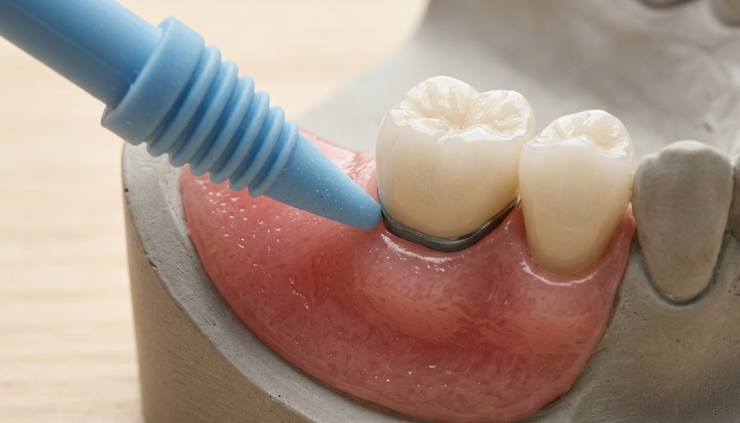
Water flossing and massage work best together
Water flossing and gum massage are not competing methods. They solve different problems.
Water flossing reaches under the bridge, around implant supports, and into spaces where food collects.
Best for flushing.
Useful after meals and before night brushing.
Works well for full arch fixed bridges.
Gum massage cleans and stimulates the soft tissue margin around crowns and implants.
Best for gentle contact cleaning.
Useful during brushing or after brushing.
Works well for daily gum checks and plaque removal at the edge.
A complete routine may look like this:
Rinse after meals if food is trapped.
Water floss once daily, often at night.
Brush with a soft brush for two minutes.
Massage the gumline gently if advised.
Use interdental brushes or floss threaders where they fit safely.
Attend professional cleaning visits on schedule.
The order can change. The key is consistency.
If time is short, do not skip brushing. Brush first, then water floss the high-risk areas. If food gets trapped after lunch, water flossing after that meal may be helpful.
Special care for cortical basal and endosseous implant cases
Full mouth implant cases differ. The dentist may use a cortical basal approach, conventional endosseous implants, or a combination. The prosthesis design also varies.
Some patients receive immediate fixed teeth. Others receive temporary teeth first, then final crowns later. Some prostheses sit close to the gum. Others have a small cleanable gap. Some are screw-retained and retrievable. Others involve cemented parts.
These details matter for cleaning.
Cortical basal implant-supported crowns
Cortical basal implant cases often aim for strong anchorage in dense cortical bone. They are commonly discussed in full mouth rehabilitation, especially when bone volume is limited.
The patient may receive fixed teeth early. That is a major benefit for someone moving away from loose dentures. But early fixed teeth can create a false sense of safety.
The bite may feel strong. The teeth may look complete. Still, the soft tissue needs careful care.
For this type of bridge, water flossing may be useful around the junctions and under the prosthesis once the clinician permits it. Gum massage must be gentle, especially if soft tissue is still healing.
Endosseous implant-supported crowns
Endosseous implants sit in the jawbone and are widely used for single teeth, multiple teeth, and full arch restorations. The tissue around the implant neck must stay clean.
Plaque at the crown-abutment area can irritate the gum. If left undisturbed, it may contribute to deeper inflammation.
Water flossing helps clean around the prosthetic contours. Interdental brushes may also help when there is enough space. The brush size matters. A brush that is too large can injure tissue. A brush that is too small may not clean well.
Why the prosthesis design should guide the routine
Ask the dental team to show the exact path for the water flosser tip. This is more useful than a general instruction like “clean well”.
A good demonstration should cover:
Where to aim the water stream
Which pressure setting to use
Where food is most likely to trap
Whether interdental brushes are allowed
What brush size is safe
Whether gum massage should start now or later
How to clean under the bridge from the tongue or palate side
Take a phone video of the demonstration if the clinic allows it. It helps at home.
What happens when cleaning is poor
Implant crowns may still look clean from the front while the underside is inflamed. That is why regular review matters.
Poor hygiene can lead to:
Bleeding gums
Bad breath
Persistent bad taste
Food impaction
Gum swelling
Calculus build-up on implant parts
Soreness under the bridge
Peri-implant mucositis
Bone loss around implants
Prosthesis complications
Bad breath is often one of the first signs. It may come from trapped debris under the full arch bridge. Mouthwash can mask it for a few hours. It will not remove hardened deposits.
Bleeding is another warning sign. Many people stop cleaning when gums bleed. This can make plaque build-up worse. Gentle cleaning should continue unless the dentist gives a different instruction. If bleeding continues, book a review.
Pain is not a reliable early warning. Implants can develop inflammation before strong pain appears.
Professional maintenance still matters
Home care removes daily plaque. It does not replace professional maintenance.
Implant prostheses need periodic checks for:
Gum inflammation
Pocket depth around implants
Bite pressure
Screw loosening
Prosthesis fit
Wear of the crowns
Calculus deposits
Bone levels on X-rays when needed
The cleaning tools used for implants differ from those used on natural teeth. Metal instruments can scratch some implant or abutment surfaces if used incorrectly. Clinics often use implant-safe instruments, air polishing, ultrasonic tips designed for implants, or other methods based on the case.
The maintenance interval depends on risk. A person with diabetes, smoking history, past gum disease, heavy calculus build-up, or poor manual dexterity may need more frequent reviews. A stable patient with excellent hygiene may need fewer visits. The dentist should set the schedule.
For many full mouth implant patients in India, travel and follow-up planning matter. If treatment is done in Bengaluru and the person lives in another city, maintenance instructions should be written down. A local dentist should also know the implant system and prosthesis type where possible.

The safest daily routine after healing
Every case is different, but this routine fits many full mouth implant crown patients after the healing period and after the dentist has approved water flossing.
Morning
Brush with a soft toothbrush. Clean the cheek side, biting surface, and tongue or palate side. Pay attention to the gumline.
If there is food or plaque under the bridge from the night, water floss lightly.
After meals
Rinse with water. If food is trapped under the prosthesis, use the water flosser on a comfortable setting.
Do not use toothpicks aggressively around implants. Wooden picks can break. Sharp objects can injure the gum.
Night
Clean more thoroughly.
Use this order:
Water floss under the bridge and around implant crowns.
Brush all crown surfaces and gum margins.
Use interdental brushes or implant floss where prescribed.
Massage gums gently with a soft brush or silicone tip.
Rinse if prescribed.
Night cleaning matters because saliva flow reduces during sleep. Plaque left overnight has more time to irritate tissue.
Weekly check
Once a week, look carefully in a mirror under good light.
Check for:
Redness
Swelling
Bleeding spots
Food-trap areas
A foul smell from one zone
Tenderness when touching the gum
Changes in speech or bite comfort
A small mirror or phone light can help. Do not poke deep into the gums.
Mistakes to avoid
Good tools can cause problems when used badly. Avoid these common mistakes.
Using maximum pressure
High pressure can hurt the gums. It is not needed for daily cleaning. Start low. Increase only if comfortable and approved.
Pointing the jet deep into the gum pocket
Aim along the gumline and under the prosthesis. Do not force water into sore, swollen, or surgical areas.
Skipping the inner side
The tongue and palate side collect plaque too. Many fixed bridge failures start in areas the patient never sees.
Scrubbing with a hard brush
Hard bristles can injure gums and scratch surfaces. Use a soft brush unless told otherwise.
Assuming no pain means no problem
Implant inflammation can stay quiet. Bleeding and bad taste may appear before pain.
Using abrasive powders or harsh home remedies
Avoid salt scrubbing, charcoal powders, baking soda abrasion, and strong chemical rinses unless prescribed. These can irritate tissue or damage surfaces.
Stopping after the final crowns are fitted
Final crowns are not the end of treatment. They are the start of long-term maintenance.
When to call the dentist
Do not wait for a scheduled review if warning signs appear.
Call the clinic if there is:
Bleeding that does not improve with gentle cleaning
Persistent swelling
Pus
Bad taste from one area
Pain while biting
A loose crown or bridge
A clicking sound from the prosthesis
Food trapping that was not present earlier
Gum recession exposing metal or implant parts
Fever or spreading facial swelling
Spreading swelling, fever, difficulty swallowing, or difficulty breathing needs urgent medical attention.
FAQ
Can I use a water flosser immediately after implant surgery?
Not unless the dentist says so. Fresh surgical sites need time to heal. Early high-pressure irrigation can disturb tender tissue or sutures. Follow the post-surgery instructions first.
Does water flossing replace normal floss?
No. It is an extra cleaning method. In full mouth implant bridges, water flossing is often easier than threading floss under every section. Still, implant floss or interdental brushes may be needed in specific areas.
Is bleeding normal when I start cleaning around implant crowns?
Mild bleeding can happen if the gums are inflamed. It should reduce with correct daily cleaning. If bleeding continues, increases, or comes with swelling or bad taste, get the area checked.
Can gum massage make implants stronger?
No. Gum massage does not make an implant integrate with bone and does not reverse bone loss. It helps clean and stimulate the soft tissue margin when done gently.
How often should I water floss full mouth implant crowns?
Many patients use it once daily, often at night. Some use it after meals if food traps under the bridge. The right frequency depends on the prosthesis design and the dentist’s advice.

The takeaway
Full mouth crowns on implants feel fixed, but they still need daily care. The weak point is not the artificial tooth surface. It is the gumline, the underside of the bridge, and the tissue around the implant supports.
Water flossing helps flush areas a brush cannot reach. Gum massage helps clean and monitor the soft tissue. Together, they reduce plaque build-up and support healthier gums.
Use the right pressure. Clean from all sides. Keep review appointments. Ask for a chairside demonstration based on the exact implant bridge in the mouth. That is the routine that protects comfort, function, and long-term stability.


Comments