Why Imex Care Prefers Corticobasal Implants for Full Mouth Cases and Endosseous Implants for Single Missing Teeth

A full mouth implant case is not just a bigger version of a single tooth implant. The biology is different. The bone loss pattern is different. The travel planning is different. The risk from gum infection is different.
At Imex Care, this is why the implant choice changes with the case.
For full mouth rehabilitation, especially in patients with severe gum infection, loose teeth, bone loss, or limited time in India, we often prefer corticobasal implants. For one or two missing teeth, we usually prefer conventional endosseous implants.
That is not a trend. It is case selection.
The basic difference between the two implant systems
Most patients hear the word “implant” and think all implants work the same way. They do not.
Both corticobasal and endosseous implants replace missing teeth. Both are placed in jaw bone. Both need careful diagnosis, sterile surgery, and a well-made prosthesis.
The difference is which bone they depend on, how they are loaded, and how they fit into the treatment plan.
Endosseous implants are the conventional root-form implants
Endosseous implants are the most common dental implants used worldwide. They look like small screws. They are placed into the jaw bone where the tooth root used to be.
They mainly depend on the alveolar bone, which is the bone that holds natural teeth. After placement, the implant usually needs time to integrate with the bone before the final crown is fixed. This biological process is known as osseointegration.
Endosseous implants work very well when:
One tooth is missing
Two teeth are missing
The bone volume is good
Gum infection is controlled
The bite is stable
The patient can return for staged treatment if needed
For single tooth replacement, they allow a natural-looking crown, good gum shaping, and a conservative approach.
Corticobasal implants engage stronger cortical bone
Corticobasal implants are designed to take support from the basal and cortical bone. This bone is deeper and more stable than the alveolar bone that often disappears after gum disease or long-term tooth loss.
Cortical bone is dense. It gives strong mechanical anchorage when the implant is placed correctly. That is why Cortical dental implants are often used in full arch cases where conventional bone volume is limited.
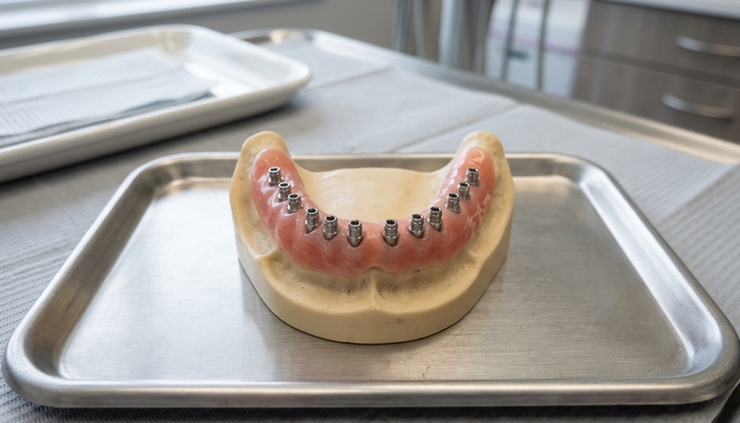
These implants are usually used with immediate loading protocols, where a fixed bridge is placed within a short treatment window after surgery. The implants are splinted together through the bridge. This helps distribute chewing forces across the arch rather than leaving each implant to work alone.
Basal dental implants follow the same broad principle of using the basal bone for support, especially in cases where the upper or lower jaw has lost a lot of tooth-supporting bone.
Why full mouth cases need a different plan
Full mouth implant treatment is complex because it involves the whole chewing system.
A single missing tooth is a local problem. A full mouth case affects:
Bite height
Jaw joint comfort
Smile line
Speech
Chewing balance
Gum infection control
Bone support
Facial support
Cleaning access
Long-term maintenance
Many full mouth patients also come with advanced gum infection. The teeth may be mobile. The gum may bleed. There may be pus discharge, bad breath, bone loss, drifting teeth, or pain while chewing.
In these cases, saving every tooth is not always healthy. If teeth have poor bone support and chronic infection, keeping them can maintain a source of infection. The first goal is to remove infection and build a stable foundation.
This is where corticobasal implants can be useful.
They allow the treatment plan to move away from weak infected tooth-supporting bone and engage stronger anatomical bone zones. In the right case, this reduces the need for large bone grafting procedures.
That matters for full mouth patients.
It matters even more for patients travelling from abroad.
Why Imex Care prefers corticobasal implants for full mouth cases
The preference comes from four practical reasons:
Full mouth cases often have severe bone loss.
Many patients have gum infection and mobile teeth.
International patients need predictable treatment timelines.
A fixed full arch bridge works best when the implants act as one unit.
They are useful when gum disease has damaged the alveolar bone
Gum infection, also called periodontal disease, damages the tissues that hold teeth in place. Over time, it can destroy the alveolar bone around teeth. This is why teeth become loose even when they look normal above the gum.
Conventional implants need enough healthy bone around the implant body. If the alveolar bone is too thin or too short, treatment may need bone grafting, sinus lift, ridge expansion, or staged healing.
These procedures can work well. But they add time, cost, surgical steps, and healing periods.
Corticobasal implants can often bypass the compromised crestal bone and engage deeper cortical bone. This is one reason they suit many full mouth cases with:
Long-standing gum disease
Loose teeth in several areas
Severe jaw bone loss
Failed bridges
Old removable dentures
Previous implant failure in weak bone
Need for fixed teeth without long grafting stages
This does not mean they are used in every case. It means they solve a specific problem well.
They reduce the need for bone grafting in many full arch cases
Bone grafting is a valuable procedure. It has a clear place in dentistry. But it is not ideal for every patient.
Grafting can require months of healing. In some upper jaw cases, a sinus lift may be needed before placing conventional implants. In thin ridges, staged augmentation may be required before the implant can be placed safely.
For someone replacing one front tooth, that timeline may be acceptable.
For a patient travelling from the Middle East, Africa, Europe, Australia, or another part of India for full mouth fixed teeth, multiple long gaps between surgeries can be difficult.
Corticobasal implants are often selected because they can reduce the need for separate grafting steps. The implant gains support from dense cortical bone areas. When the case is suitable, this shortens the treatment pathway.
This is one of the main reasons Imex Care uses them for full mouth cases in Bengaluru.

They fit immediate fixed teeth protocols better
Full mouth treatment is not just about placing implants. It is also about giving teeth that can function.
In corticobasal full arch cases, the implants are commonly connected with a rigid fixed bridge soon after placement. This matters because the bridge splints the implants. It helps control micromovement and spreads forces across the arch.
Think of it like standing on one stick versus standing on a raft made of connected supports. The raft distributes load better.
For full mouth cases, splinting is often a key part of the biomechanics.
This is why isolated, unsplinted planning can fail in high-load full arch cases, especially when the bite is heavy or bone support is limited.
A full arch bridge allows the clinician to design:
Stable bite contacts
Correct tooth position
Balanced chewing forces
Proper vertical height
Better lip and cheek support
Cleaning spaces under the bridge
This treatment still needs discipline. During early healing, the patient must follow food instructions. Hard chewing too early can overload the implants or prosthesis.
Immediate teeth do not mean careless chewing. They mean controlled function.
They are practical for patients travelling from abroad
Dental tourism works only when the timeline is realistic. Patients travelling from outside India often cannot stay for several months or return many times.
A conventional full mouth implant plan may need:
Extraction
Healing
Bone grafting
More healing
Implant placement
Osseointegration period
Second-stage surgery
Temporary teeth
Final prosthesis
This can be excellent treatment. But it does not suit every international patient.
A corticobasal full mouth protocol can often be planned in a shorter clinical schedule. The typical advantage is fewer surgical stages and quicker fixed provisional teeth, when the case is suitable.
That helps patients who must plan around:
Flight dates
Visa duration
Work leave
Family responsibilities
Accommodation in Bengaluru
Follow-up availability
Medical fitness for multiple surgeries
Clinicians still need to be strict. Speed cannot replace diagnosis. A full mouth case needs clinical examination, scans, medical history review, bite assessment, and infection control.
The right question is not “Which implant is fastest?”
The right question is “Which implant system gives stable support for this patient’s bone, infection status, bite, and travel window?”
Why Imex Care prefers endosseous implants for one or two missing teeth
For one or two missing teeth, conventional endosseous implants are usually the better choice.
The reason is simple. A small problem should not need a full arch solution.
If a patient has one missing molar, one missing premolar, or one missing front tooth with good bone around the site, an endosseous implant is predictable and conservative.
They are precise for local tooth replacement
A single endosseous implant replaces one missing tooth without involving the rest of the arch.
This is useful when the neighbouring teeth are healthy. There is no need to cut them down for a bridge. There is no need to change the full bite. The implant is placed in the missing tooth space, and a crown is made to match the bite and smile.
Endosseous implants offer good control over:
Crown shape
Gum contour
Tooth emergence profile
Contact with adjacent teeth
Cleaning access
Local bite force
For front teeth, soft tissue shaping is critical. The gum line, papilla, and crown angle matter. A conventional implant system gives many prosthetic options for this kind of precise crown work.
They make sense when bone is available
When one or two teeth are missing, the surrounding bone is often still usable, especially if the tooth was removed recently or the infection was localised.
In these cases, conventional implant planning is straightforward.
The dental team can assess:
Bone height
Bone width
Distance from nerves or sinus
Gum thickness
Adjacent root position
Bite load
Smile zone requirements
If the site is suitable, an endosseous implant can be placed with minimal surgical trauma.
If minor grafting is needed, it may still be manageable because the area is small. A small socket graft or guided bone regeneration procedure is very different from rebuilding an entire arch.
They avoid overtreatment
Using a full arch strategy for one or two missing teeth would be overtreatment in most cases.
Corticobasal systems work best when their strengths are needed, such as full arch rehabilitation, poor crestal bone, or a need for immediate splinted support.
For single teeth, those strengths may not matter. The implant does not need to be part of a cross-arch bridge. It does not need to compensate for widespread gum infection. It does not need to replace a collapsing bite.
A conventional endosseous implant is often simpler, more targeted, and easier to maintain as an individual tooth replacement.
The role of gum infection in implant choice
Gum infection changes everything.
An implant cannot be planned only from a missing tooth count. The mouth must be assessed for active disease.
Signs that need attention include:
Bleeding while brushing
Swollen gums
Bad breath that does not improve
Loose teeth
Pus near gums
Teeth shifting position
Food packing between teeth
Pain while chewing
Deep gum pockets
Bone loss on X-ray or CBCT
If infection remains active, implant treatment becomes riskier. The source of infection must be removed or controlled.
For single tooth cases, this may mean cleaning, root surface debridement, extraction of the hopeless tooth, and healing before implant placement.
For full mouth cases, it may mean removing several infected teeth and planning a complete fixed rehabilitation.
This is why two patients with “missing teeth” may receive different implant recommendations.
One may need one endosseous implant. Another may need full mouth corticobasal rehabilitation.
The difference is not preference alone. It is diagnosis.

How Imex Care decides between corticobasal and endosseous implants
The decision is based on clinical findings. Not on a fixed package.
A good implant plan starts with a few direct questions.
How many teeth are missing or failing?
One missing tooth usually points towards an endosseous implant.
A full arch of failing teeth may point towards corticobasal implants, especially if the teeth are loose due to gum disease.
The number of teeth involved changes the treatment goal. A single crown must blend with the mouth. A full arch must rebuild function.
How much healthy bone is available?
Bone volume matters. Bone quality matters too.
Conventional endosseous implants need enough bone around the implant for stability and long-term support. When the bone is deficient, grafting may be needed.
Corticobasal implants are designed to engage dense cortical bone. This can help in cases where the jaw has lost a lot of tooth-bearing bone.
CBCT imaging helps the clinician see the bone in three dimensions. This is more useful than a flat X-ray for complex implant cases.
Is there active gum infection?
Active infection must be addressed before or during implant treatment.
For local infection around one tooth, the solution may be extraction, cleaning, and later implant placement.
For widespread periodontal infection, the plan may involve removing hopeless teeth and rehabilitating the whole arch.
The key is to avoid placing implants into an unhealthy environment without a disease control plan.
Can the patient return for multiple stages?
This matters for patients travelling from abroad.
A staged conventional full mouth plan may be clinically sound, but not practical for everyone. If the patient cannot return many times, the treatment plan must reflect that.
Corticobasal full arch treatment can reduce the number of surgical stages in selected cases.
For one or two teeth, the visit pattern is usually easier to manage, even with conventional implants. The surgery is smaller. Healing can be tracked. The final crown can be planned during a later visit or with a coordinated schedule.
What kind of prosthesis is needed?
The prosthesis drives the implant plan.
A single missing tooth needs an individual crown.
A full mouth case may need a fixed bridge across the arch. The bridge must restore bite height, chewing surfaces, speech, and facial support.
Corticobasal implants work well when a rigid full arch bridge can connect the implants and distribute forces.
Endosseous implants work well when each implant can support a single crown or a short bridge in good bone.
A clear comparison helps patients understand the choice
Treatment factor | Corticobasal implants for full mouth cases | Endosseous implants for one or two missing teeth |
Main support | Dense cortical and basal bone | Alveolar jaw bone at the missing tooth site |
Best use | Full arch or full mouth rehabilitation | Single tooth or small gap replacement |
Common need for grafting | Often reduced in suitable cases | May be needed if local bone is weak |
Loading approach | Often immediate with a splinted bridge | Often staged, depending on stability and site |
Travel suitability | Useful for many international full mouth cases | Suitable for limited missing tooth cases with planned follow-up |
Prosthesis | Fixed full arch bridge | Single crown or short bridge |
Gum disease cases | Useful when several teeth are failing and bone loss is severe | Useful after local infection control in small cases |
Main planning risk | Needs strong bite design and rigid splinting | Needs enough local bone and good gum health |
No table can replace an examination. But the pattern is clear.
Corticobasal implants solve full mouth problems well when bone loss and travel limits are major issues. Endosseous implants solve small missing tooth problems well when the local site is healthy enough.
What patients travelling to Bengaluru should plan for
International and outstation patients need more than surgery. They need a planned timeline.
Before travel, the dental team may ask for:
Recent dental X-rays or CBCT if available
Medical history
Current medication list
Diabetes status if relevant
Smoking history
Previous implant details if any
Photos of teeth and smile
Details of pain, swelling, bleeding, or pus
Some decisions can be estimated before arrival. Final decisions need an in-person examination and imaging.
For full mouth corticobasal cases, the treatment window must include time for:
Clinical diagnosis
Blood pressure and medical checks if needed
CBCT scan
Extractions if required
Implant placement
Jaw relation records
Trial of teeth where possible
Fixed bridge fabrication
Bite corrections
Hygiene instructions
Review before travel
For one or two endosseous implants, the schedule may be shorter for surgery, but the final crown may require a later phase depending on the case.
Travel patients should not rush the last review. Bite adjustment after bridge or crown placement is not optional. Small bite errors can create large force problems.
What “immediate teeth” really means
Many patients ask for fixed teeth quickly. That is understandable. Removable dentures can feel uncomfortable. Missing front teeth affect speech and confidence. Full mouth tooth loss affects diet.
But immediate loading has rules.
Immediate teeth mean the prosthesis is placed soon after implant surgery, when primary stability and case design allow it.
It does not mean:
Chewing hard nuts immediately
Biting bones or hard crusts
Ignoring cleaning instructions
Skipping review visits
Treating the bridge like natural teeth from day one
In full arch corticobasal cases, the bridge protects the implants by connecting them. But overload can still cause trouble.
Patients are usually advised to follow a soft diet during early healing. The exact duration depends on the clinician’s protocol and the patient’s bone, bite, and prosthesis.
The first few weeks matter.
When corticobasal implants may not be the right choice
Corticobasal implants are powerful tools, but they are not for every situation.
They may not be the best option when:
Only one tooth is missing and the bone is good
The patient wants a single independent crown
The bite does not need full arch correction
The mouth has enough bone for simple endosseous treatment
The patient cannot follow post-surgery instructions
Medical conditions make surgery unsafe without clearance
Oral hygiene is too poor to maintain a fixed bridge
A full arch bridge needs cleaning under the prosthesis. Food can collect if hygiene is neglected. Water flossers, interdental brushes, and regular maintenance visits may be needed.
A fixed solution still needs daily care.
When endosseous implants may not be enough
Endosseous implants are excellent for selected cases. But they may not solve every full mouth problem.
They may become less suitable when:
Bone loss is severe across the arch
Several teeth are mobile from gum disease
Sinus position limits upper jaw implant placement
The patient wants to avoid large grafting procedures
Multiple staged surgeries are not practical
The bite has collapsed
A full mouth fixed bridge is needed quickly
Past dentures have failed due to poor retention
In these conditions, using conventional implants may still be possible, but the plan can become longer and more surgical.
That is when corticobasal planning may offer a better route.

What matters more than the implant type
Patients often ask which implant is “best”. The better question is whether the whole plan is sound.
A successful implant case depends on:
Correct diagnosis
Infection control
Bone assessment
Medical assessment
Implant positioning
Bite design
Prosthesis quality
Lab accuracy
Patient hygiene
Follow-up care
The implant is one part of the system.
A poorly planned implant can fail even if the implant brand is good. A well-planned case has a better chance because the biology, mechanics, and prosthesis work together.
For gum infection and missing teeth cases, the most important step is to stop disease before rebuilding teeth. Fixed teeth placed over untreated infection are a poor foundation.
FAQ
Are corticobasal implants better than endosseous implants?
They are better for some cases, not all. Corticobasal implants are often useful for full mouth cases with severe bone loss, gum disease, or limited travel time. Endosseous implants are usually better for one or two missing teeth when local bone is healthy.
Can implants be placed if there is gum infection?
Active gum infection must be treated. In hopeless teeth, extraction may be needed. In some full mouth cases, infected teeth are removed and implants are placed using a plan that avoids weak infected bone zones. The exact approach depends on examination and scans.
How long should an international patient stay for full mouth implant treatment?
The stay depends on the case, the number of teeth involved, the prosthesis, medical status, and lab work. Full mouth immediate loading cases need enough time for surgery, prosthesis fabrication, bite correction, and review before flying back.
Do endosseous implants always need bone grafting?
No. If the missing tooth site has enough bone, grafting may not be needed. If the bone is thin or short, a graft may be advised. Small local grafting is common in some cases, but it is not automatic.
Are immediate fixed teeth the same as permanent final teeth?
Not always. Some cases receive a long-term fixed bridge early. Others may receive a provisional bridge first and a final prosthesis later. The choice depends on the implant system, bite, material, and treatment plan.
The practical takeaway
At Imex Care, the implant choice follows the case.
For full mouth rehabilitation, especially with gum infection, loose teeth, severe bone loss, or patients travelling from abroad, corticobasal implants often give a practical and stable path to fixed teeth.
For one or two missing teeth, endosseous implants remain the preferred option in most cases. They are conservative, precise, and well suited to local tooth replacement.
The goal is not to use one implant system for every mouth. The goal is to use the right system for the bone, infection status, bite, prosthesis, and patient schedule.
This article is for general information only. A clinical examination, CBCT scan, and medical review are needed before choosing any implant treatment.


Comments